As the influence and military capabilities of China continue to grow across the Pacific, the United States and Australia have declared intentions to enhance their defense collaboration and enhance regional deterrence.
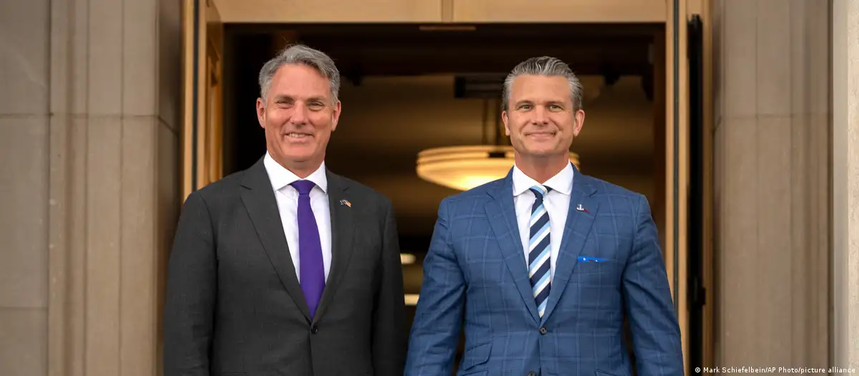
On Wednesday, US Defense Secretary Pete Hegseth and Australian Defense Minister Richard Marles held a meeting in Washington, where both leaders stressed the importance of ensuring a positive balance of power in the region.
Hegseth reported that Australia had learned the lesson of having a positive balance of power in the region, and Marles reported that the US military presence in Australia was increasing due to what he termed as the largest conventional military buildup by any nation since the Second World War.
Marles said that we must be making sure that we create deterrence, that we create balance, in order to be able to secure the peace and stability of the region in which we live.
In the latest agreement, the two nations will speed up force-posture programs at Australian military bases, increase collaboration in joint logistics and enhance interoperability by conducting joint military drills, as stated by the Pentagon.
These force-posture arrangements enable US forces to train and store equipment in Australia, such as by rotational deployments of aircraft and logistical support of US naval vessels.
Australia does not permit foreign military bases on its territory, but it hosts major joint exercises and rotational deployments of US Marines in Darwin. It is not clear whether the new deal will lead to an increased permanent US troop presence in the country.
The Pentagon indicated that Hegseth and Marles also talked about the progress in cooperation to establish shared capabilities in the form of guided weapons and next-generation military technologies.
Hegseth reported that Washington and Canberra had very similar defense plans. He also stressed the need of allies to enhance their own sovereign defense capabilities but to make sure that their military planning and capabilities are complementary.
In recent years, Australia has been increasing its defense capabilities, such as by enhancing its long-range missile strike capability and deepening strategic alliances.
The AUKUS agreement with Britain is also part of the US-Australia defense relationship. The US defense personnel are currently serving in the HMAS Stirling naval base in Western Australia under the agreement that is likely to host a rotating force of US-controlled submarines starting 2027.
China has condemned AUKUS as a threat and has threatened that the security alliance would lead to an arms race in the area.