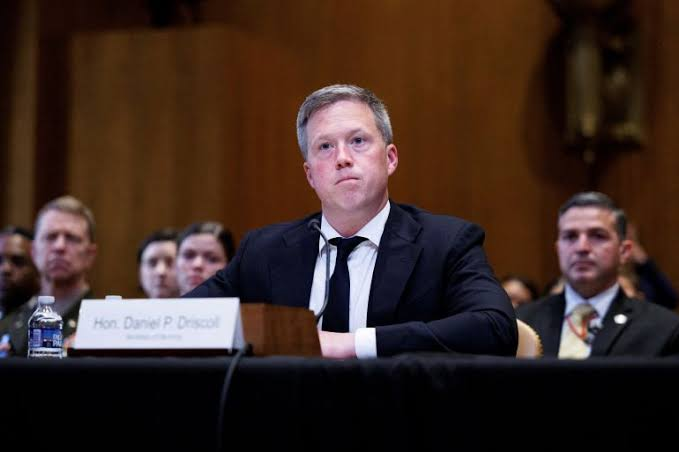
WASHINGTON: U.S. Army Secretary Dan Driscoll has resigned to the White House after months of strains with Defense Secretary Pete Hegseth, a source close to the situation confirmed.
The most recent senior official to resign or be forced out by Hegseth at the Pentagon is Driscoll, who officials say has close connections to the U.S. Vice President JD Vance. His resignation is at a time when the United States is still at war with Iran and thousands of U.S. Army soldiers are stationed throughout the Middle East.
More Stories: Uber Introduces Fully Autonomous Baidu Robotaxis in Dubai
It was not immediately clear whether the White House had accepted Driscoll’s resignation.
The source states that Driscoll had already brought up the issue of Army transformation and military readiness with the administration, and what he considered to be the attempts of Hegseth to prevent such efforts, such as the firing of generals who were in charge of such efforts.
The Army declined to comment on the report, which was first published by the Wall Street Journal.
White House spokeswoman Anna Kelly praised Driscoll’s tenure, saying he had been highly effective in advancing President Donald Trump’s agenda to “Make America Strong Again” at the Department of the Army. She attributed him with leadership in significant military operations, enhancing the Army emphasis on readiness and lethality, and involvement in negotiations between Russia and Ukraine.
Increasing Tensions with Hegseth
Driscoll, who became confirmed as Army secretary in February 2025, had advocated the Army to be more adaptable in obtaining less expensive weapons and had publicly criticized large defense contractors.
Large defense companies were conned by the defense industrial base, in general, and the primes, in particular, Driscoll said last year.
Earlier Stories: Libya Stands with Algeria following Deadly Fires
A U.S. official, who requested anonymity, claimed that Hegseth considered Driscoll a threat to the Pentagon bureaucracy and had long desired to get rid of him. Nevertheless, Driscoll was allegedly harder to push out because of his relationship with Vance.
Driscoll also rose to prominence beyond the Pentagon when Trump chose him to join talks with Moscow and Kyiv to end the war in Ukraine, an uncharacteristic diplomatic position of an Army secretary.
The relationship between Driscoll and Hegseth is said to have escalated in April when Hegseth dismissed U.S. Army Chief of Staff Randy George, a significant change in leadership that occurred when the U.S. military was in the middle of a major conflict in the Middle East.
The official reported that George was fired unexpectedly, which made Driscoll feel even more frustrated with Hegseth.
Read This: Liby and Syria Discuss the Bilateral Relations and Cooperation
Driscoll subsequently informed legislators that after George was fired, his family drove to the home of the former general to console and comfort him.
In June, Hegseth also blocked the promotions of several senior Army officials, including the head of U.S. Army forces in Europe, himself, further raising questions about leadership and personnel transitions in the service.