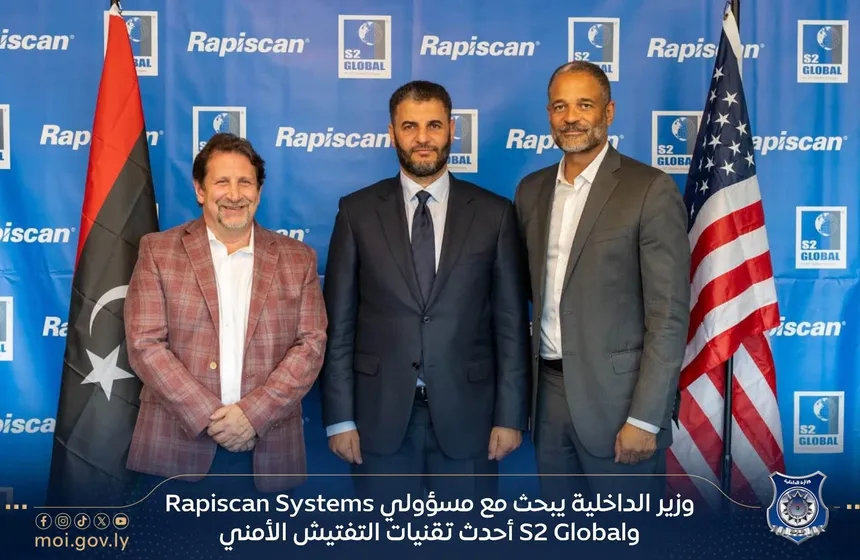
During his visit to the United States this week, Interior Minister Major General Imad Trabelsi met with representatives of US security technology firms Rapiscan Systems and S2 Global, and the Tripoli-based Libyan government has announced plans to boost security inspection systems at the country’s entry points.
The talks centered on the enhancement of security screening facilities at Libya’s borders, airports and seaports, including advanced non-intrusive inspection technologies for vehicles, containers, cargo, luggage and persons.
The officials also spoke about technologies for detecting explosives, narcotics, radioactive materials and other prohibited items, X-ray image analysis and systems for managing and processing screening data.
The proposed systems would enable inspection results to be linked with shipment information, operational records and security databases. Such integration could give the authorities a more complete picture of inspection activity, improve risk assessment and help identify shipments, vehicles or persons that need more attention, the Libyan government said.
More News: Al-Bunya Advances 7,000-Tower Telecom Infrastructure Project in Libya
The method could also enable authorities to adopt either a comprehensive screening or multi-stage, risk-based inspection process. This would allow security agencies to keep a closer eye on things without disrupting the flow of goods and passengers.
The current talks are a continuation of previous meetings between Libyan officials and the two firms during their trips to Tripoli. Those talks, which have been ongoing for about 14 months, included technical, operational and training needs, and the particular needs of Libya’s air, land and maritime entry points.
The project is designed to enhance the efficiency of the supervision at the Libyan borders and boost the early detection of contraband, dangerous materials and other security threats. It also aims to improve the ability to fight smuggling with more advanced inspection and risk assessment.
Local expertise development is a key part of the initiative. The project aims to train and qualify Libyan personnel, transfer technical knowledge and enhance national capacities in system operation, maintenance and management.
The government said building these capabilities would help ensure the long-term sustainability of the upgraded inspection infrastructure and reduce dependence on external expertise by placing greater responsibility in the hands of trained Libyan personnel.
Security and Sovereign Decision-Making to Remain with Libyan Institutions
The talks are part of a wider plan by the Tripoli government to modernize Libya’s border-crossing capabilities and replace traditional inspection methods with non-intrusive scanning, advanced image and data analysis and risk-based assessment.
The modernization is designed to enhance border security and ensure the efficient flow of trade and passengers. Meanwhile, the government reiterated that security supervision and sovereign decision-making would remain in the hands of Libyan state institutions.
The project thus integrates cutting-edge screening technology with local training and institutional capacity building, with the government aiming to enhance border security while maintaining its control over the operation, management and strategic application of its inspection systems.